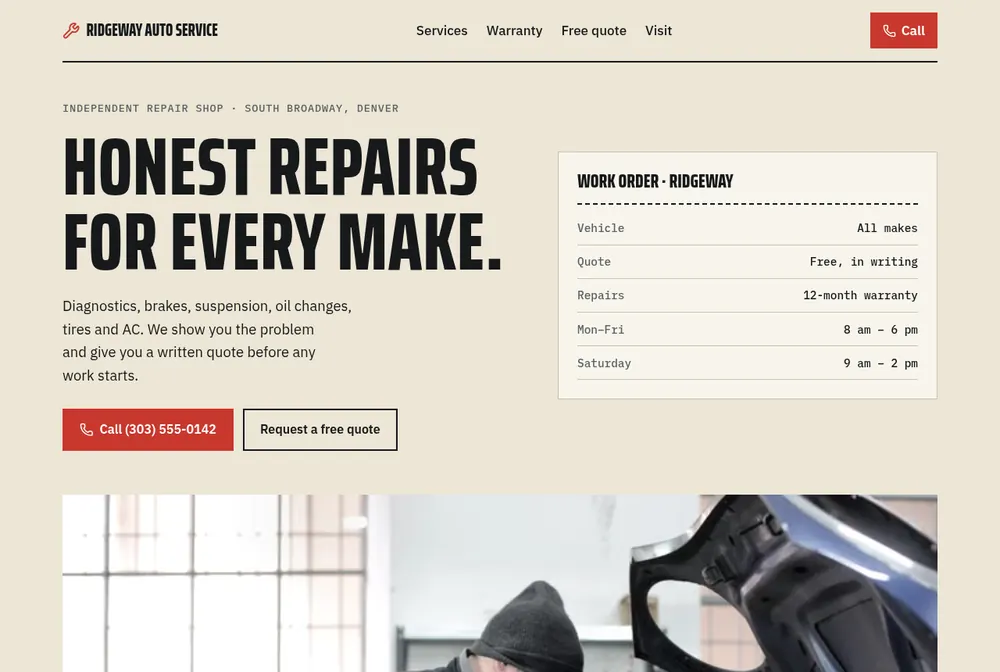
Why trust comes first for a garage
In a 2016 AAA survey of US drivers, two-thirds said they don't trust repair shops in general, most often because of recommendations for work that isn't needed (76%) and overcharging (73%); 64% had found a shop they do trust (AAA, 2016). Your website is where you show you're the second kind. What helps most:
- Prices for routine work: servicing, inspections (MOT, TÜV and the like), diagnostics, brakes, tyres.
- How estimates work: a written estimate first, a phone call before any extra work, old parts shown on request.
- A guarantee on parts and labour, written down.
- Certifications you can back up (ASE in the US, IMI or Motor Ombudsman in the UK), the makes you know well, and whether you work on hybrids and electric cars.
- Convenience: booking, early drop-off or a key box, a courtesy car, opening hours.
"Will servicing here void my warranty?"
It's one of the most common worries, and you can answer it:
- EU: under the motor-vehicle competition rules, manufacturers shouldn't make warranties depend on servicing within their own network, or refuse warranty claims just because an independent garage did the maintenance (European Commission FAQ). The UK has its own similar order.
- US: the FTC says warranties generally can't be voided just because you used an independent shop (FTC).
The condition: the service must follow the manufacturer's schedule with parts of matching quality. A line like "We service to the manufacturer's schedule with quality parts, so your warranty stays valid" is worth putting on the page, if it's true for you. In California, shops must also give a written estimate before work and can't go over it without consent (BAR guide). General information, not legal advice.
The sections a garage website needs
- Top of the page: your services, your area, Book a service and Call.
- Services with prices, fixed where you can.
- How we work: estimate first, a call before extra work, your guarantee.
- Certifications, makes, and electric or hybrid work.
- Booking or a request form with the car, the registration or plate number, and the problem.
- Hours, location, drop-off and courtesy car.
- Reviews and questions, the warranty one first.
Mistakes we see on garage websites
- No prices at all.
- "All makes and models", with nothing specific.
- Booking forms with no field for the car or the problem.
- Opening hours hidden at the bottom.
- Bodywork and mechanical work mixed together without explanation.
- Logos of certifications the shop doesn't hold. Customers can check many of them.
Getting found locally
Choose "Auto repair shop" on Google Business Profile and add other categories only for real lines of business (tyres,
brakes, inspections). In structured data you're an AutoRepair business (plus AutoBodyShop if you do bodywork); Ginta
writes it from the details you gave.
How it works with Ginta
Describe the shop and answer the questions; it's live in about a minute. On a paid plan, Bookings lets drivers pick a service and a slot (you set the durations, opening hours, breaks and days off), with a confirmation email and their own link to change it. For anything that needs a look first, Quote requests collects the car, the problem and photos of the damage, and you track each job from new to won. Post "Closed for inspections training on Friday" as an announcement that disappears by itself.
Questions
Will servicing my car at an independent garage void the warranty?
In the EU, UK and US, generally not, as long as the service follows the manufacturer's schedule with parts of matching quality. Say so on your website: it's a top worry.
Should a garage show prices online?
Show fixed prices for routine jobs (servicing, inspection, diagnostics) and explain how estimates and approvals work for everything else. Clear prices are your strongest trust signal.
Do I need online booking?
It helps. A booking or a request with the car, the plate number, a preferred date and the problem saves phone time, and you confirm the slot yourself.
What builds trust on a garage website?
Real photos of your workshop and team, certifications you can prove, a written guarantee on work, recent reviews, and a clear promise to call before doing extra work.