What customers look for in an electrician
Proof is what sets an electrician's website apart from other trades:
- Registration they can check. Which scheme or licence depends on where you work (below), and customers increasingly look you up. A logo alone isn't proof: give your number, or a link to the register.
- The certificate they'll receive. Homeowners need it for building control, insurance, or when they sell.
- Home or business work, clearly separated: a homeowner and a facilities manager look for different things.
- Specialist work you're approved for: EV chargers, rewires, consumer units (fuse boxes), inspections and reports, solar and batteries, lighting.
- How quotes work: a free survey or not, fixed quotes, call-out charges, emergencies.
Registrations: which ones to show
- England and Wales: notifiable electrical work in homes must meet Part P of the Building Regulations. The usual route is an electrician registered with a competent-person scheme such as NICEIC or NAPIT, who can self-certify the work (IET).
- Ireland: restricted electrical work may only be done by a Safe Electric Registered Electrical Contractor, who issues a completion certificate. The regulator prosecutes unregistered work and false claims of registration (CRU).
- United States: a state electrical contractor licence; in California the licence number must appear in all advertising, websites included (CSLB).
- New South Wales: the licence number must appear in advertising, online too.
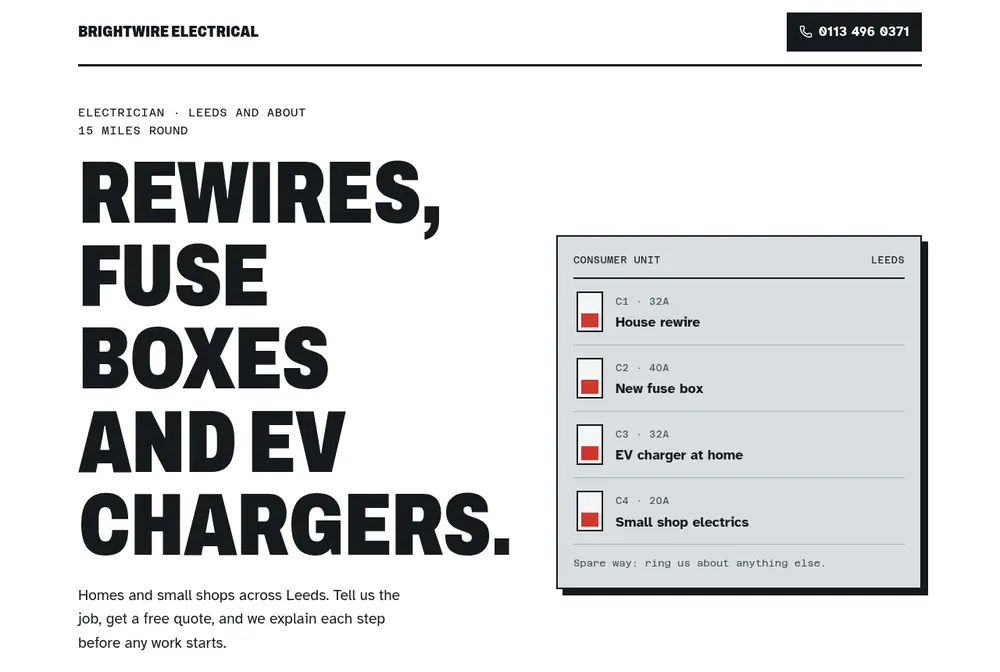
Only ever show registrations you hold. (Our example site above is fictional, so it shows none.)
The sections an electrician's website needs
- Top of the page: what you do and where, Call and Get a quote buttons, your registration.
- Services, split by home and business, with a short paragraph on your big ones (EV chargers, rewires, inspections).
- Registrations, insurance and the certificates you issue.
- Areas covered.
- How pricing works: survey, day rate, fixed quotes.
- Photos of real jobs: tidy consumer units, finished lighting.
- Reviews and a quote form with photos.
Mistakes we see on electricians' websites
- Scheme logos with no number or link to check.
- Home and commercial work mixed together.
- No mention of certificates.
- "Emergency electrician" with a phone nobody answers at night.
- A plumber's template with the word changed: the trust signals people want are different.
Getting found locally
On Google Business Profile, choose "Electrician" and, if you travel to customers, set up as a service-area business
with the places you cover (service areas). If you do EV chargers,
say so in words on the website: it's a separate search. In structured data you're an Electrician with the areas you
serve; Ginta adds it with only the details you gave.
How it works with Ginta
Our example above took 77 seconds from the answers to a live website. Add Quote requests so customers can describe the job step by step and send photos of the fuse box or the wall where the charger should go; you track each request (new, quoted, won, lost) with your own notes. A Gallery of your real jobs, managed by you, builds the trust logos can't.
Questions
What makes an electrician's website trustworthy?
Your registration or licence numbers with a way to check them, the certificates you issue, real photos of your work and recent reviews.
Should I list EV charger installation separately?
Yes, if you do it. People search for it on its own, and they want to see that you're approved for it.
Home and commercial work on one website?
That's fine, but split them clearly into two sections, each with its own examples.
Do I need online booking?
Usually a quote request with photos works better than a calendar: most electrical jobs need a look before you can give a time and a price.