What people look for when they need a plumber
- "Can you come now?" If you do emergencies, say so, and only say "24/7" if someone really answers at 3 am.
- A number they can tap, at the top of every screen on a phone.
- The areas you cover, by town or postcode, not "and surrounding areas".
- How you charge: call-out fee, hourly or fixed price, out-of-hours rates, whether VAT and parts are included. Which? advises customers to describe the problem and notes that a plumber should be able to tell them the call-out price (Which?).
- Credentials they can check, real photos of your van and work, and reviews.
Credentials: show the ones that apply to you
- UK: anyone working on gas appliances such as boilers must be on the Gas Safe Register, and customers can check an engineer's number online (Gas Safe Register). If you do gas work, show your number.
- California: contractors must put their licence number in all advertising, websites included (CSLB). Other states have similar rules.
- New South Wales: the licence number must appear in advertising, online too (NSW Government).
- EU: where professional insurance is compulsory, customers must be able to see the insurer and the cover (Services Directive, Article 22).
Never show a badge or number you don't hold: it's misleading and, for gas work in the UK, illegal. Rules differ by country; check your own.
The sections a plumber's website needs
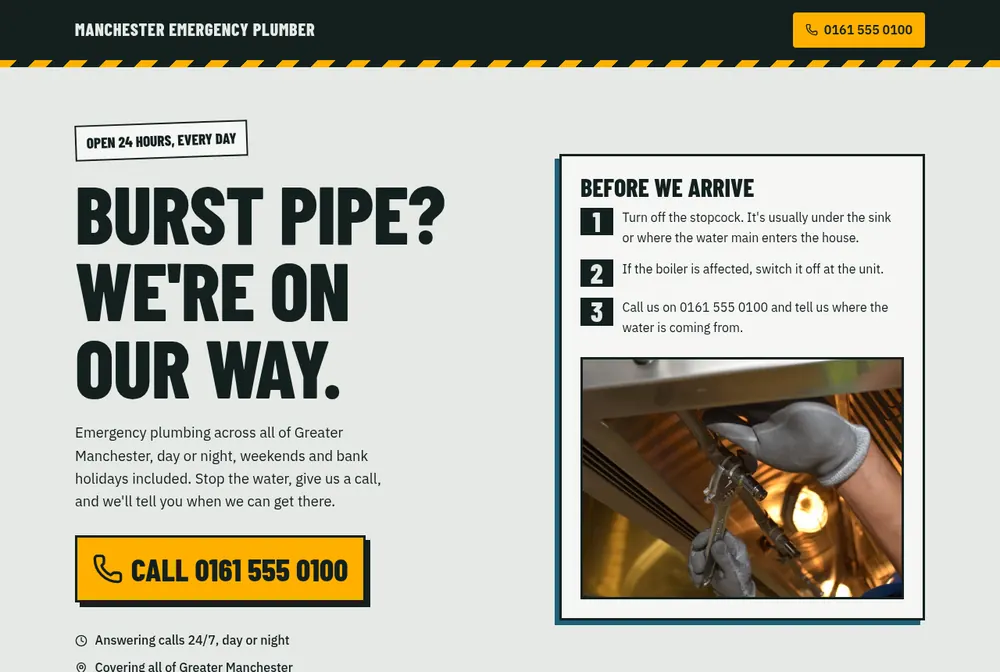
- Top of the page: "Emergency plumber in [area]" (only if true), a big Call button, your hours.
- Services: leaks, blocked drains, boilers or water heaters, bathrooms, each with a short paragraph.
- Areas covered, the same list as on your Google profile.
- Prices and how you charge.
- Credentials, insurance and your guarantee on work.
- Reviews and photos of real jobs.
- A quote request form with photos, because a picture of the leak says more than a description.
Mistakes we see on plumbers' websites
- The phone number buried in the footer, or not tappable.
- No prices at all, so people call three others first.
- Stock photos of models in clean overalls.
- A keyword-stuffed business name ("Best Cheap Emergency Plumber London"). Google's guidelines ask for your real name, and stuffing it can get your profile suspended (guidelines).
Getting found locally
Most plumbers work at customers' homes, so Google treats you as a service-area business: hide your home address and
list up to 20 areas you serve, within about two hours' drive of your base
(service areas). In structured data you're a Plumber with the
places you serve; Ginta writes it from what you told it.
How it works with Ginta
Describe the business ("emergency plumber in Leeds, boilers and leaks"), answer the questions, and you're live in about a minute with the call button where a stressed person looks first. Then add Quote requests: a step-by-step form where customers describe the job, answer your own questions and add photos; you track each request as new, quoted, won or lost. Ginta's quote requests are on every plan, the Free plan included.
Questions
What should a plumber's website show first?
Your phone number as a button, the areas you cover, and whether you do emergencies. Someone with a leak decides in seconds.
Should plumbers put prices online?
Show how you charge (call-out, hourly or fixed, out-of-hours) and typical starting prices. Exact quotes can wait, but surprises cost you reviews.
Do I have to show my licence number on my website?
In some places, yes: California and New South Wales, for example. In the UK, showing your Gas Safe number for gas work is strongly expected. Check your local rules.
Do I need a page for every town I cover?
Not at first. List your areas clearly on one page. Separate town pages only make sense when you have something truly local to say, like jobs you've done there.