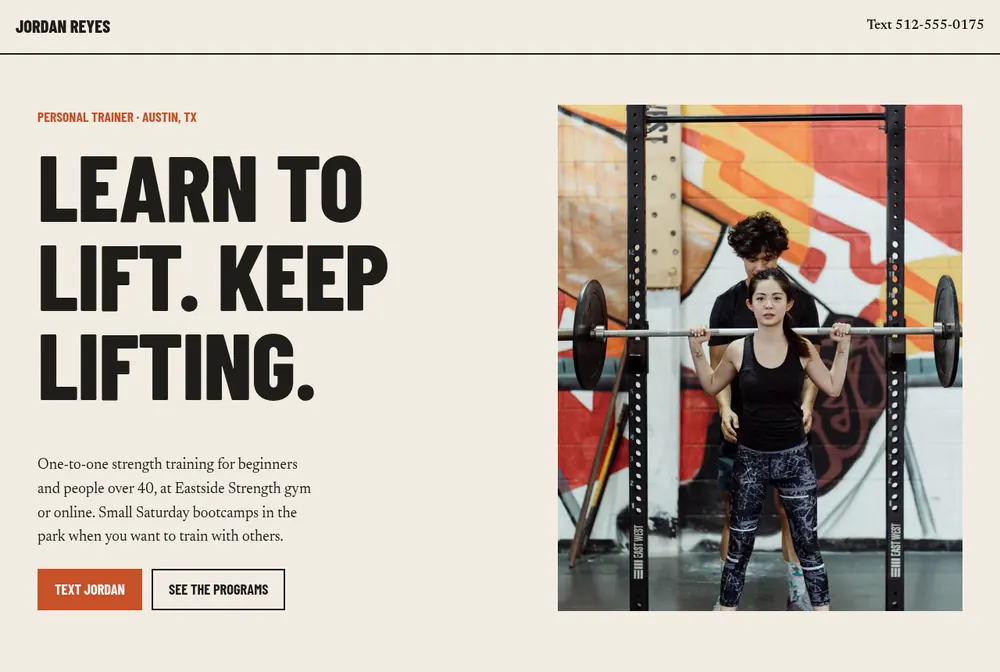
What people look for in a personal trainer
- Who you help. Beginners, people over 40, new mums, strength, a sport. A clear niche is easier to choose.
- Where training happens: your own studio, a gym, their home, a park, or online. Many trainers forget to say it.
- Qualifications they can check. In the UK a Level 3 qualification and CIMSPA registration (CIMSPA); across Europe the EREPS register (EREPS); in the US a certification from an NCCA-accredited programme (NCCA). Explain the letters after your name, and link to the register.
- Prices: per session, blocks of sessions, monthly coaching, a free first chat or trial.
- Real results, told honestly, and your photo and personality.
The sections a trainer's website needs
- Top of the page: who you help, where, and Book a free first chat.
- About you and your qualifications, with links to check them, and your insurance.
- Ways to train, with prices: one to one, small groups, online.
- Where we train: the gym or area, how far you travel, online.
- Results and reviews.
- How it starts: the first chat, the health questions, the plan.
- Booking, and a timetable if you run classes.
Two things many trainers get wrong
Google Maps and other people's gyms. Google Business Profile isn't for "an ongoing service, class, or meeting at a location that you don't own or have the authority to represent" (eligibility), and online-only businesses aren't eligible. So you can't list the gym you train in as your business. You can list your own studio, or set up as a service-area business if you travel to clients.
Health questionnaires. The usual pre-exercise questions (heart conditions, medication, injuries) are health data, a special category under GDPR in the EU and UK. Don't collect them through an ordinary contact form: use a proper form with explicit consent and a privacy notice, or go through them in person at the first session. Avoid medical claims and transformation promises that sound like guarantees. This is general information, not legal advice.
Getting found locally
Choose "Personal trainer" on Google Business Profile, with your own studio or your service areas. In structured data, a
trainer with their own studio can be an ExerciseGym; a mobile or online trainer is a LocalBusiness with the areas
served. Ginta picks the type from what you told it.
How it works with Ginta
Our example took 81 seconds from the answers to a live site, and its contact form doesn't ask for health details. On a paid plan, add Bookings for one-to-one sessions (clients pick a free time and get a calendar entry), Events for your Saturday bootcamp with a set number of places, a waiting list and a reminder the day before, and the Shop for blocks of sessions. Payments through your own Stripe account are built and opening soon; until then people book and you take payment as you do today.
Questions
What should a personal trainer's website include?
Who you train, where you train them, your qualifications with a way to check them, your prices or packages, real reviews, and one simple way to book a first chat.
Should I put my prices on my website?
Yes, at least starting prices or package prices. Most people won't book a first chat without a rough idea of the cost.
Can I collect health questionnaires through my website?
Be careful: in the EU and UK that's sensitive health data. Use a secure form with explicit consent and a privacy notice, or do it at the first session.
Can I get on Google Maps if I train clients in a gym I don't own?
Not at the gym's address. List your own studio, or set up as a service-area business if you travel to clients. Online-only coaching isn't eligible.