How to sell your own clothing brand online
To sell your own clothing brand online, put each piece on its own page with size and colour as choices (each combination with its own stock), add a size guide with real measurements, show the clothes on a person and up close, write a clear returns policy, and set delivery prices that cover a heavy hoodie as well as a cap. Most of the work is in the size guide and the photos: they decide how many orders come back. This post is about your own designs, not second-hand clothes.
We make Ginta. The example, Northline Studio, is a made-up brand of organic cotton basics from Copenhagen, built as a demo with Ginta's Shop: hoodies, tees, caps, a set and gift cards.
1. One product, many sizes and colours
A hoodie in four sizes and three colours is one product with twelve combinations, not twelve products. Buyers pick a size and a colour on the product page; the price, photo and stock follow the combination they picked. On Northline's page the line is simply "Pick your size and colour on each product. Sold-out combinations are crossed out."
In Ginta's Shop a product can have up to two kinds of options (usually size and colour), with up to 100 combinations, each with its own price, sale price, stock and photo. A product with options counts as one product against the plan's limit, so the free plan's 25 products per website can mean a few hundred size-and-colour combinations.
Track stock per combination from the start. One size and colour will sell out before the others, and a buyer who orders one you don't have means a refund and an apology.
2. A size guide that prevents returns
A size guide is a page section or a table, not a feature you need to buy. What to put in it:
- Measurements of the garment, not just "S, M, L": chest width, length, sleeve, in centimetres (and inches if you ship to the US or UK).
- How it fits: relaxed, regular, close. Northline adds one line that answers the most common question: "Between your usual sizes? Take the smaller one for a closer fit."
- The model's height and size under each on-body photo.
- Fabric and care: weight, shrinkage after washing, how to wash it.
Link the size guide from every product page, near the size choice.
3. Photos
Show each piece on a person (front, back, side) and flat or on a hanger, with a close-up of the fabric, the seams and any print. Photograph every colour; a buyer who orders "sand" expects the colour in your photo. Keep the light and background the same across the collection. In Ginta each combination can have its own photo, so choosing "Colour: Black" shows the black one.
4. A returns policy people can find
Fit is hard to judge on a screen, so expect some returns. Decide your rules before the first order and put them on every product page and in the footer.
In the EU, consumers who buy online can cancel within 14 days without giving a reason, counted from delivery for goods, with exceptions such as goods made to order or clearly personalised (Your Europe: returns). You can give longer: Northline's demo gives 30 days. Check your own country's consumer rules; this isn't legal advice.
For selling shops, Ginta adds its own Seller information and Returns and right of withdrawal pages (in 9 languages, written as a starting point for you to check, not as legal advice). Buyers can ask for a return from their order page, and you refund in full or in part from Ginta.
5. Delivery that covers heavy and light orders
A hoodie and a beanie cost very different amounts to post. Two ways to price it fairly:
- By weight: give each product its weight and set price steps per zone (delivery by weight).
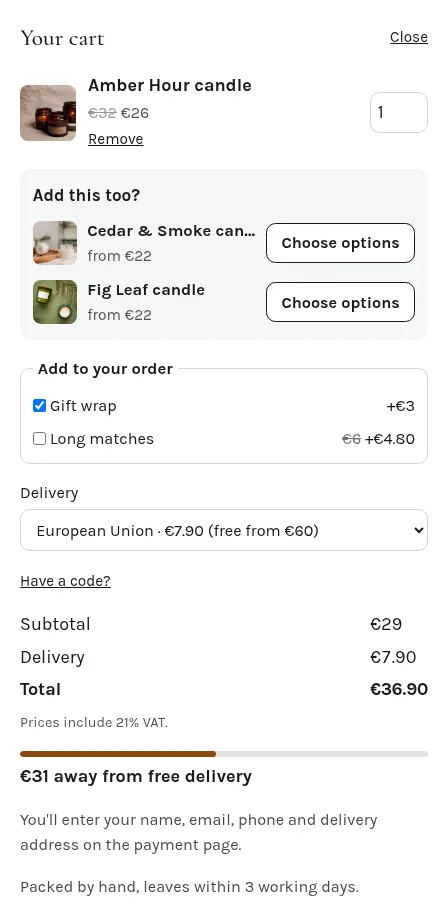
- Free from an amount: Northline charges €5 in Denmark, free from €80, €9 in the rest of the EU and €14 to the UK. The cart shows how far the buyer is from free delivery.
6. Drops, sales and restocks
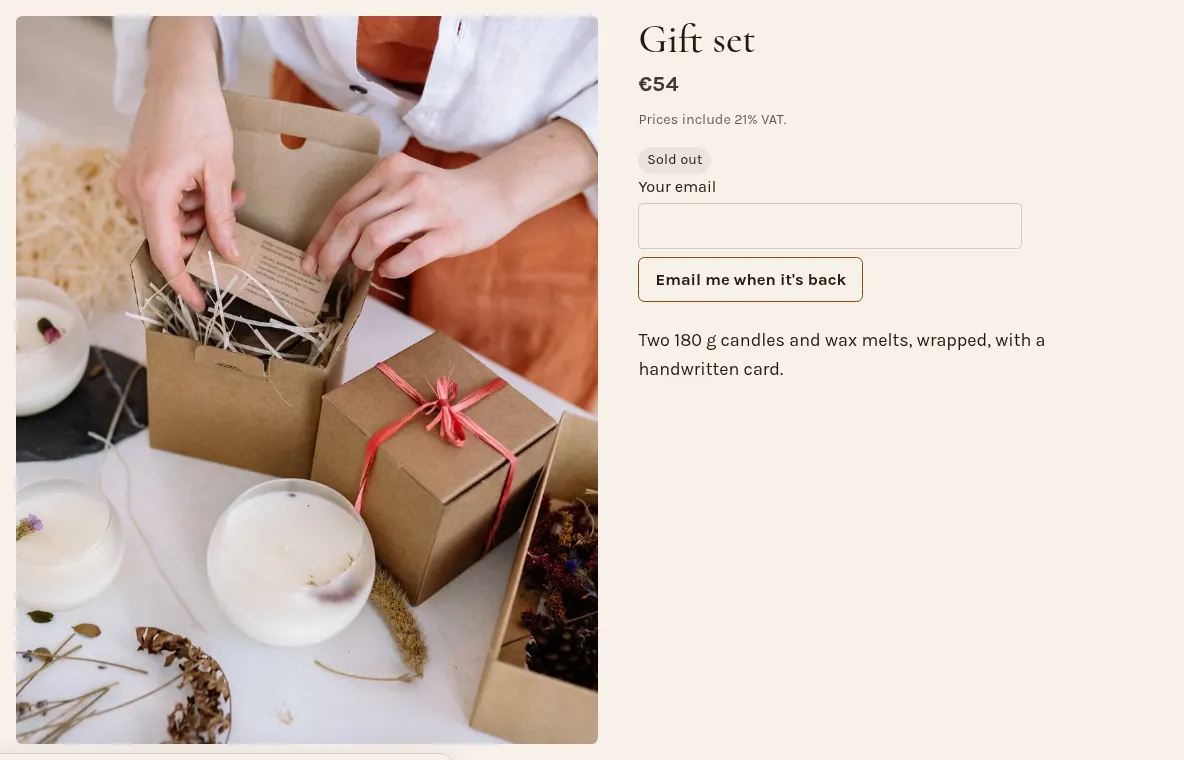
- Back-in-stock emails. On a sold-out piece, buyers leave their email and get one when it's back (back-in-stock emails). Useful after a drop sells out.
- Sets and multi-buy prices. Northline sells a beanie and tote set at its own price; "buy 2 tees, save 10%" is a volume price (bundles and volume discounts).
- Sale prices with the old price struck through, and automatic discounts that need no code.
- Gift cards for people who don't know the size.
7. Where other tools are better
Be honest about what your brand needs:
- Print-on-demand. If a printer makes and ships each order, you want a platform that connects to one. Big Cartel lists print-on-demand apps (Big Cartel pricing) and Shopify has an app store with thousands of apps (Shopify pricing). Ginta has no app store.
- Pop-ups and markets with a card reader. Square and Shopify sell in person; Ginta has no point of sale.
- Prices in several currencies, PayPal, or customer accounts with logins. Ginta has one currency per shop, takes payment by card, Apple Pay and Google Pay through Stripe, and has no customer logins.
What it costs
Ginta's free plan includes the whole Shop, up to 25 products per website, at a name.ginta.page address
with a small "Made with Ginta" badge. Your own domain and no badge start at €5 a month (if you build
with your own Claude or ChatGPT) or €19 a month on Light with Ginta's AI. Buyers pay into your own Stripe
account; Ginta takes 0% and Stripe charges its card fee, for example 1.5% + €0.25 for a standard EEA card
(Stripe pricing). Everything the Shop does is on Ginta Commerce; ideas
for brands are on websites for clothing brands.
Questions
How do I sell clothes in different sizes online?
Make each piece one product with size (and colour) as options, give every combination its own stock, and show a size guide next to the size choice. Sold-out combinations should be visible but not orderable.
Do I have to accept returns on clothes?
In the EU, people who buy online can cancel within 14 days of delivery without a reason, with exceptions such as made to order or clearly personalised items. Outside the EU, check your country's consumer rules. You can always give longer than the law asks.
Can I sell my clothing brand online for free?
Yes, with limits. Ginta's free plan has the full Shop for up to 25 products per website (each with its sizes and colours) and takes card payments through your own Stripe. Card fees apply to every sale.
How do I reduce returns on clothes?
Answer the fit and colour questions before the order: real garment measurements, a fit note, the model's height and size, and photos of every colour in honest light.
Written with AI help for Ginta, which Povilas runs; he also teaches a website-building course. The screenshots are from the real Ginta on the date above, and prices come from our pricing page.