How to sell candles online: a practical start
To sell candles online, start with a small range (a few scents in two sizes), get the safety warnings and labels right for the country you sell in, photograph your own candles well, and open a small shop where each candle has its own page with the sizes as choices. Then work out shipping for heavy glass jars, and plan for people buying them as presents. You can start for free. Below is each step, with two real example shops made with Ginta.
We make Ginta. The two shops are made-up businesses built to show how it works: Salt & Wick (Fremantle, Australia, built by Ginta's AI on the free plan) and Wick & Hollow (Vilnius, a demo shop with gift cards and multi-buy offers).
1. Start with a small range
A first collection of three to six scents is easier to make, photograph, stock and explain than twenty. Give each scent a short, concrete description of what it smells like: Salt & Wick's "Fig & Cedar" is "Green fig leaf over warm cedar wood". Say what's in the jar (wax, wick, burn time) once, on the page, not on every product.
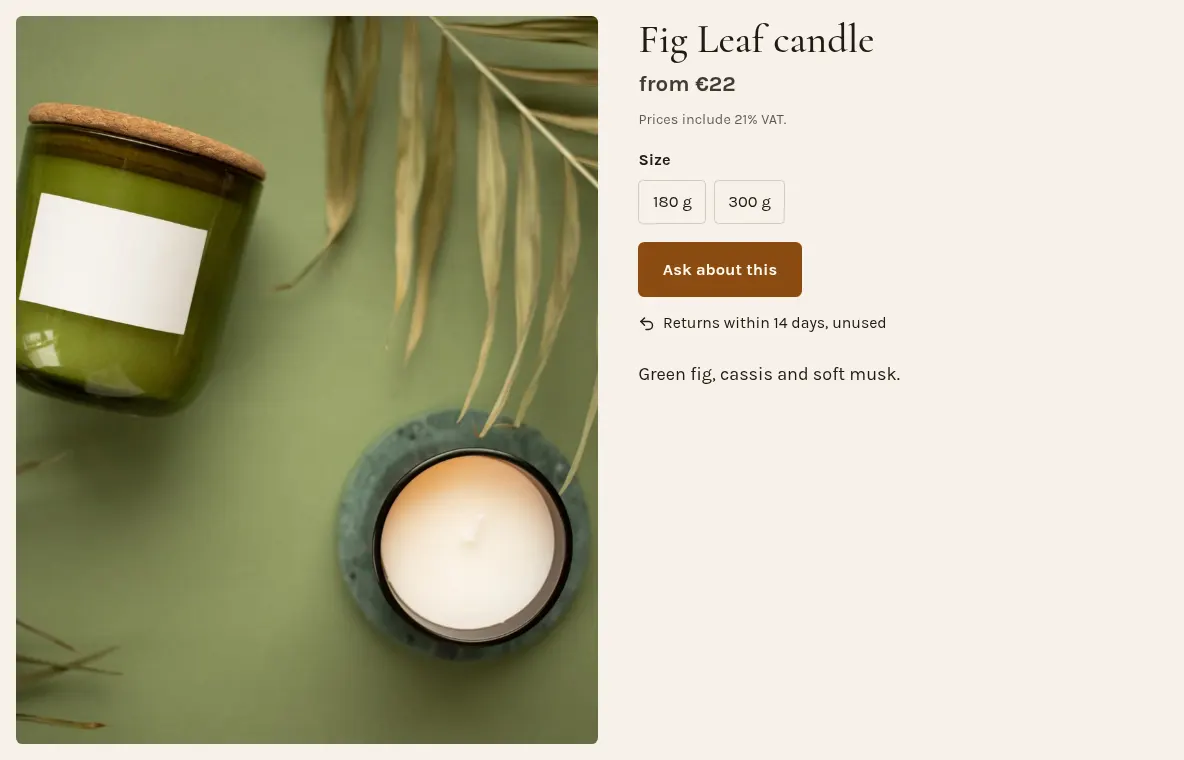
Make sizes an option on one product, not separate products. A buyer opens "Fig Leaf candle", picks 180 g or 300 g, and the price changes. In Ginta's Shop a product can have up to two kinds of options (for example size and scent), with up to 100 combinations, each with its own price, sale price, stock and photo, and a product with options counts as one product.
2. Safety warnings and labels
Candles are a fire risk, so most countries have rules on safety information. This is not legal advice, and rules change; check the official guidance for every country you sell to. Some starting points we checked on 8 November 2026:
- European Union. The General Product Safety Regulation applies to products offered online to EU consumers. Its Article 19 says an online offer must clearly show the manufacturer's name and postal and electronic address (and an EU responsible person if the maker is outside the EU), information to identify the product including a picture, and any warning or safety information in a language buyers easily understand (Regulation (EU) 2023/988 on EUR-Lex). In practice: put your candle's safety warnings on its product page as well as on the label.
- Great Britain. The Office for Product Safety and Standards points businesses to their local council's Trading Standards team for advice (Product safety advice for businesses).
- United States. The CPSC's candle page says metal-cored wicks must not contain lead, candles containing a hazardous substance under the Federal Hazardous Substances Act must carry cautionary labelling, and lists ASTM F2058 (candle fire safety labelling) among the voluntary standards (CPSC: Candles).
Fragrance oils can bring their own labelling rules. Ask your supplier for the safety information that comes with each oil and check what your country requires before you print labels.
3. Photos that sell a smell
Buyers can't smell a candle through a screen, so photos and words do the work. Take a few of each candle: lit in a dim room, unlit in daylight, in a hand for scale, the label close up, and the lid or packaging. Keep the same light and background across the range so the shop looks like one collection. Use your own photos; stock pictures of candles look like every other shop.
4. Price for the jar, not just the wax
Glass jars are heavy and fragile, which makes postage a real part of the price. Weigh a packed parcel of each size, then decide what you charge per country or zone. Two common ways:
- By weight: postage goes up in steps as the parcel gets heavier, so two large candles cost more to post than one. Ginta works this out from each product's weight (delivery by weight).
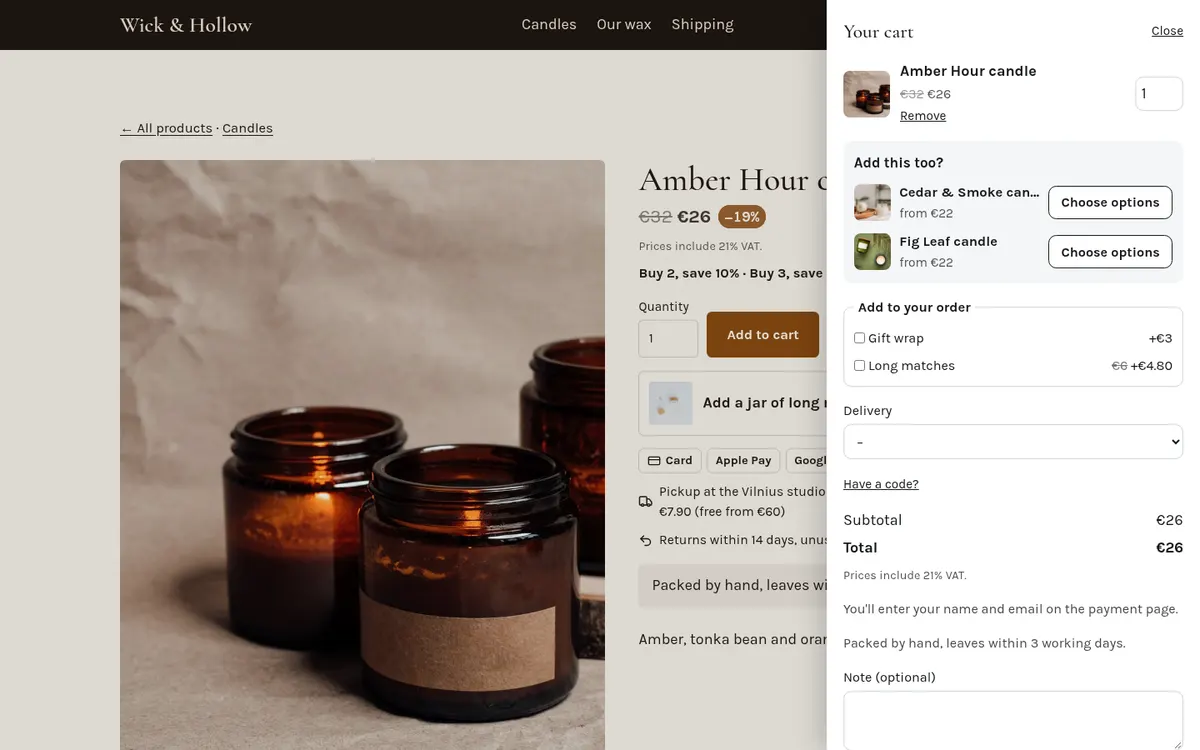
- Free from an amount: for example free delivery from €60, which also nudges buyers to add a second candle. Wick & Hollow charges €7.90 within the EU, free from €60, and the cart shows how far the buyer is from free delivery.
Local buyers can collect for free: Salt & Wick offers free pickup in Fremantle.
5. Plan for gifts
If people buy your candles as presents, these help:
- Gift sets at their own price (two small candles, or a candle and wax melts). In Ginta a set uses each part's stock, so you don't sell a set you can't pack.
- Gift cards, emailed to the person the buyer names, with a message (gift cards).
- Add-ons in the cart: gift wrap or long matches, never ticked in advance (upsells and add-ons).
- A gift message at checkout, and an "Email me when it's back" button on sold-out sets.
6. Where to sell: a marketplace, markets or your own shop
- Etsy brings buyers who are already searching, at a price: in the US $0.20 a listing, 6.5% of each order and payment processing of 3% + $0.25 (Etsy fee basics, payment processing).
- Markets and shops let people smell before they buy. Put your web address on every label so the second candle can be bought online.
- Your own shop keeps the customer and the margin, but brings no buyers by itself: you send them, from Instagram, markets, packaging and Google. You can run Etsy and your own shop side by side. Ginta vs Etsy compares the two.
7. Open the shop
With Ginta you describe the business ("hand-poured soy candles from Fremantle, four scents in 200 g and 400 g, wax melts, a gift set, shipping in Australia $9.95, free over $80, free pickup") and the website with its shop is built from that: product pages, a cart, delivery and pickup. You then manage products, stock and orders yourself in Ginta's Shop, no AI needed. Connect your own Stripe account and buyers pay by card, Apple Pay or Google Pay; the money goes to your Stripe account and Ginta takes 0%. Stripe charges its card fee, for example 1.5% + €0.25 for a standard EEA card (Stripe pricing).
The free plan includes the whole Shop, up to 25 products per website, at a name.ginta.page address with
a small "Made with Ginta" badge. Your own domain starts at €5 a month (if you build with your own Claude
or ChatGPT) or €19 on Light with Ginta's AI. Everything the Shop does is on Ginta Commerce;
candle-specific ideas are on websites for candle makers.
Questions
Do I need a licence to sell candles online?
It depends on your country, so check its official guidance. Whether or not a licence is needed, product safety rules, labels and business registration apply. In the EU, an online offer must show your name, address and the candle's safety information; in Great Britain, your council's Trading Standards team can advise.
Can I sell candles online for free?
Yes, with limits. Ginta's free plan has a full shop for up to 25 products per website and takes card payments through your own Stripe; Big Cartel's free plan holds 5 products. Card fees apply to every sale.
How should I price candles?
Add up wax, fragrance, wick, jar, label and packaging per candle, then your time, then the card fee. Decide postage separately, by weight or as a flat price per country, and say clearly when delivery is free.
Should I sell on Etsy or my own website?
Both, if you can. Etsy brings searchers; your own website brings the people you send and keeps more of each sale. Link your website from your labels, packaging and social profiles.
Written with AI help for Ginta, which Povilas runs; he also teaches a website-building course. The screenshots are from the real Ginta on the date above, and prices come from our pricing page.