Can Claude or ChatGPT build an online store? Yes, with a real cart and checkout
Claude and ChatGPT can design and write every page of an online store, but on their own they can't hold a cart, take payments or count stock: that needs a server and a payment provider. So you either have a developer connect those (for example Stripe and a database), use a shop platform such as Shopify, or connect your AI to a host whose shop does that part for you. With Ginta's MCP server, your Claude or ChatGPT builds the shop, and payments go into your own Stripe account with no fee from Ginta.
Facts about other companies come from their own pages, checked on 20 November 2026 (links in each section). We make Ginta.
What the AI can do alone, and what it can't
Ask Claude or ChatGPT for "an online shop for my candles" and you get good-looking HTML: a product grid, product pages, maybe a cart drawer written in JavaScript. It looks finished. But a real shop also has to:
- trust its prices. Anyone can change a price in their own browser, so the total must be worked out on a server.
- count stock, so two people can't buy the last one.
- take the payment on a secure page, and only then mark the order as paid.
- tell you about the order, email the buyer, and keep a record for refunds and taxes.
None of that can live in a page. A chat assistant writes files; it doesn't run a server for you after the chat ends. That's the gap every route below has to fill.
Route 1: the AI writes the code, you run the backend
With a coding assistant such as Claude Code (included in Claude's paid plans, not in Free: Claude pricing), you can build the whole thing: a database for products and orders, Stripe Checkout for payment, a webhook that marks orders as paid, hosting for all of it.
This works, and it's the most flexible route. It also means you own every part that can break: webhooks that fail silently, stock that goes below zero, tax and delivery rules, security updates, and the bill for the hosting. It suits developers. For a small business owner it's a project, not an afternoon.
Route 2: Shopify, with AI tools on top
"Can Claude build a Shopify store?" Partly. Shopify publishes an AI Toolkit that connects coding tools such as Claude Code, Codex and Cursor to Shopify's developer docs, API schemas and its command-line store management. That helps a developer build and edit a Shopify store with an AI. You still need a Shopify store underneath.
On Shopify's pricing page (shown in euros), Basic is €27 a month billed monthly or €19 a month billed yearly, with a trial of 3 days free and then €1 a month for 3 months. Online card payments through Shopify Payments start at 1.8% + €0.25, and Shopify adds a 2% fee when you use another payment provider. In return you get a mature platform with an app store, point of sale and a huge ecosystem, which Ginta doesn't have.
Route 3: your AI builds, the host runs the shop
The third way is to connect your assistant to a website host that already has a shop behind it. The AI writes the
pages; the host keeps the cart, prices, stock and checkout on its server. Ginta works this way: it runs an MCP server
at https://ginta.app/mcp with 19 tools, and one of them sets up and changes the Shop.
What Ginta's Shop does on the server, whichever AI wrote the pages:
- products with photos, categories, sale prices and stock counts, each with its own page,
- sizes or colours (up to two kinds of options per product), each combination with its own price and stock,
- delivery options per country, free delivery over an amount, pickup,
- discount codes, checked and priced by the server,
- payment on Stripe's checkout page, into your own Stripe account. Ginta takes 0%; Stripe charges its own fee (for a standard EEA card, 1.5% + €0.25: Stripe pricing),
- order emails, PDF receipts, refunds from Ginta, and the orders in one inbox.
The AI can draw the shop in Ginta's own look, or in a design of its own: with data-headless on the shop's
placeholder, Ginta draws nothing and gives the page a small helper (window.GintaShop) to read products and fill the
cart. The prices still come from the server.
A real run: Claude builds a macramé shop
For this post, Claude (connected to Ginta through MCP) built Tide & Twine, a demo shop for macramé plant hangers that doesn't exist. These were the steps, all through Ginta's tools:
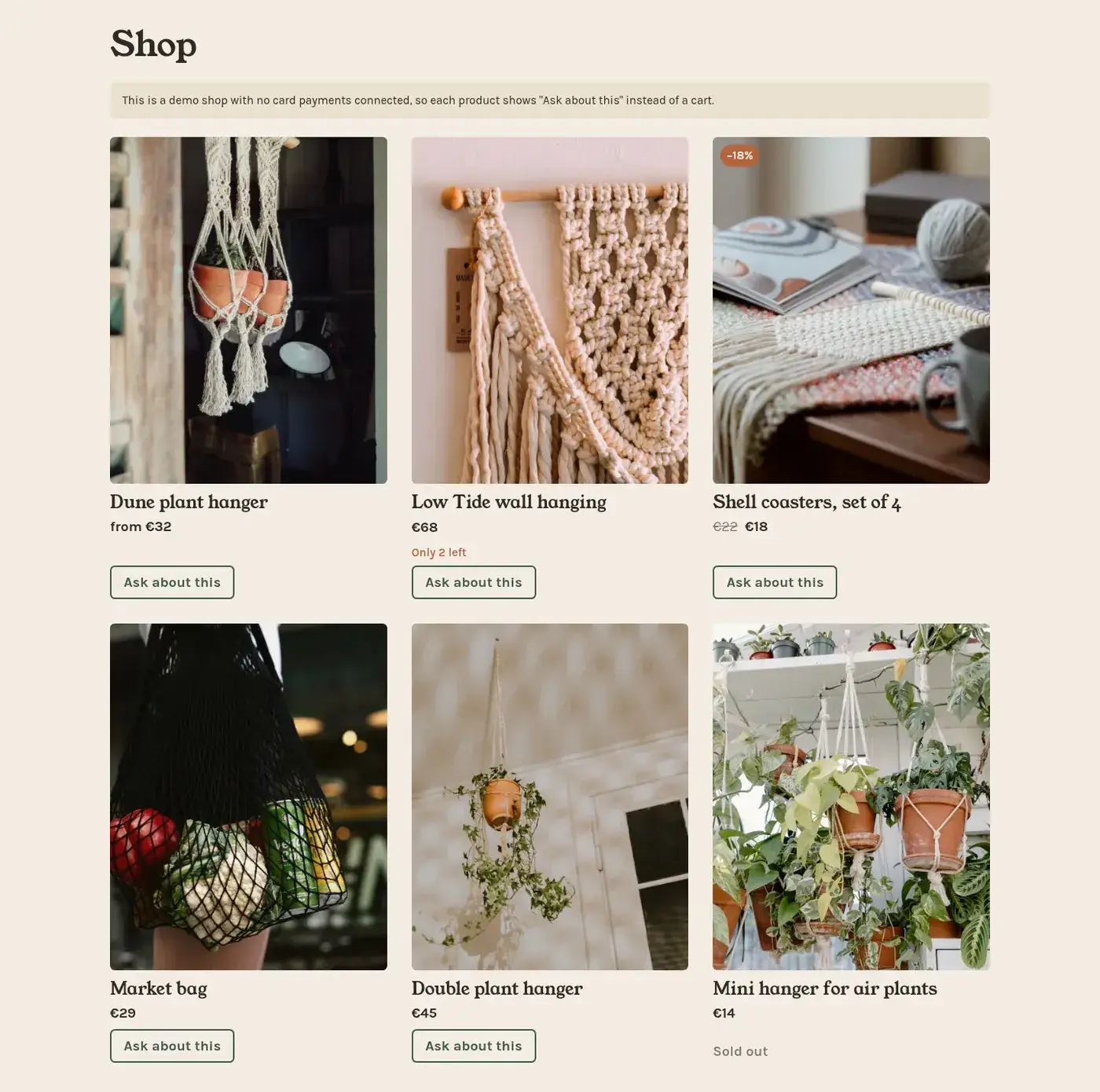
get_guide: read how Ginta sites and the Shop work.create_site: made the address tide-and-twine.ginta.page.manage_module(Shop,setup): six products with prices and photos, one with two lengths at different prices, a sale price, a limited stock count, a sold-out item, two delivery options (Ireland, and the rest of the EU, free in Ireland over €60) and a 10% code.- Upload of the pages: Claude wrote the shop grid and cart in its own design, reading everything from the Shop.
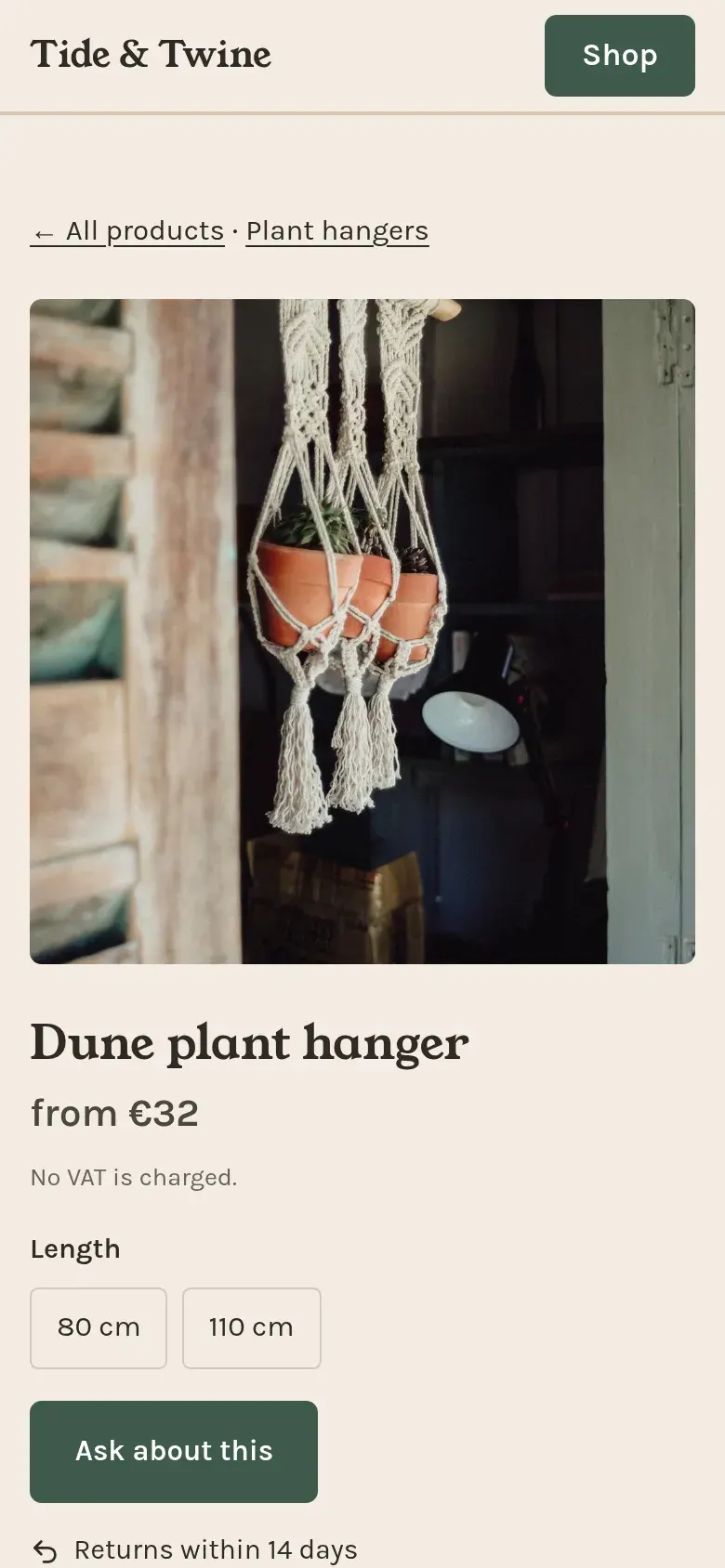
Each product gets its own page from Ginta, with the site's header and footer, the length choice and the returns line:
This demo has no Stripe connected, so the buttons say Ask about this (a message to the owner) instead of Add to cart. That's what any Ginta shop does until its owner connects Stripe: nobody can pay into a shop that can't take the money. Once Stripe is connected, the same page shows the cart and checkout; a live example of the cart is in how to add a shopping cart to an HTML website.
To try it yourself: connect Ginta in Claude (Ginta in Claude's directory) or in ChatGPT (the steps), then ask for your shop. Your AI asks for your products and prices; it shouldn't invent them.
What Ginta's Shop can't do
Say it plainly before you choose it:
- No digital downloads (e-books, files) and no subscriptions or repeat deliveries.
- One currency per shop, no point of sale, no shipping labels or live carrier rates, no customer accounts with logins.
- No marketplace: buyers come from your own website, links and ads, not from Ginta.
- Card payments need Stripe in a country Stripe supports. Without it, a shop can send orders to you on WhatsApp, or take questions.
- At most 500 products per website on paid plans; 25 on Free.
What each route costs
| AI + your own backend | Shopify | AI + Ginta | |
|---|---|---|---|
| Monthly fee | your hosting and database | from €19 a month (yearly) | Free; own domain from €5 a month |
| Fee per sale | Stripe's fee | from 1.8% + €0.25, +2% with another provider | 0% from Ginta, Stripe's fee |
| Who builds it | you or a developer | you, or a developer with AI tools | your Claude or ChatGPT |
| Who runs cart and payment | you | Shopify | Ginta |
On Ginta's Free plan the shop lives at a name.ginta.page address with a small "Made with Ginta" badge, and building
through Claude or ChatGPT uses no Ginta credits. Your own domain comes with Hosting (€5 a month, for
people who build with their own AI) or Light (€19 a month, with Ginta's own AI). All prices:
pricing.
Questions
Can Claude build a Shopify store for me?
Claude can write Shopify theme code and, with Shopify's AI Toolkit in a coding tool like Claude Code, work with your store through Shopify's own tools. You still need a Shopify plan. If you only want a shop and don't need Shopify, Claude can build one on a host with a shop behind it, such as Ginta, through MCP.
Can ChatGPT make a working checkout?
ChatGPT can write a checkout page, but the payment has to happen on a payment provider's page, checked by a server. Connected to Ginta, ChatGPT sets up the products and Ginta sends buyers to Stripe's checkout on your own Stripe account.
Do I need to know how to code?
No, not for route 3. You describe what you sell in the chat; the AI calls Ginta's tools. You connect Stripe yourself in Ginta, because only you can open your Stripe account.
Where does the money go?
Straight into your own Stripe account. Ginta never holds it and takes 0%; Stripe charges its fee for each payment.
Can my AI add products later?
Yes. Ask it to add, change or mark products sold out, and it uses the same tool. You can also do it yourself in the website's Parts tab in Ginta, or import a CSV from Shopify, Etsy or WooCommerce.
Can I sell digital products?
Not with Ginta's Shop today: it sells physical products, with delivery or pickup. For downloads you'd need another service.
Written with AI help for Ginta, which Povilas runs; he also teaches a website-building course. The screenshots are from the real Ginta on the date above, and prices come from our pricing page.