What buyers of handmade work check before they buy
- What it's made of, and where the material comes from (fallen Irish ash, recycled silver, local wool).
- The size, in numbers: about 30 cm, 45 × 18 cm, 100 ml.
- How it's made, and the honest line that each piece is a little different from the photo.
- Care: how to wash it, oil it, keep it.
- Personalising: a name, a date, initials, and what that does to returns.
- Shipping and time: what it costs, how soon it leaves, and whether made-to-order takes longer.
The sections a maker's website needs
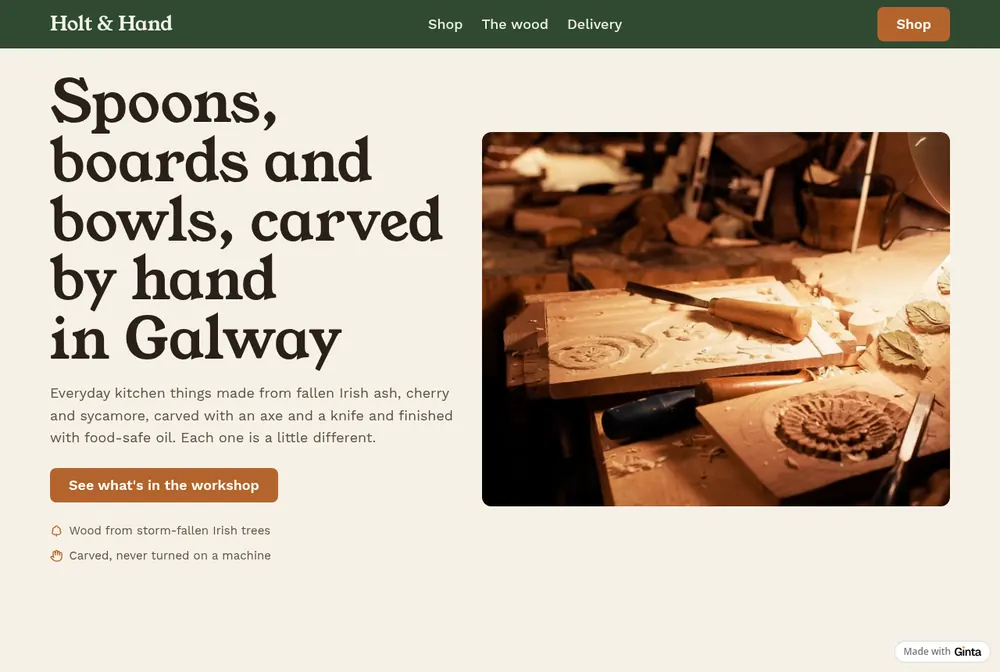
- Top of the page: what you make and where, a button to the shop, two short lines on what makes it yours.
- The shop, by kind (spoons, sets, boards, bowls, care).
- The material and the making, with photos from the workshop.
- Delivery and returns.
- Care.
- About you and contact, for commissions, wholesale and markets you'll be at.
One-offs, small batches and "Email me when it's back"
Holt & Hand's carved bowl is one of a kind and sold out; its page stays up with its photo and story. In a shop that takes card payments, a sold-out product shows "Email me when it's back": people leave their email, and when you mark it in stock again each of them gets one email. (The demo has no Stripe connected, so its buttons say Ask about this instead.)
Batch work gets a count: the shop knows there are 12 eating spoons and 3 chopping boards, counts down with every paid order, and marks a product sold out at zero, so you never sell a board you don't have.
Sets and "cheaper by two or three"
- Volume prices: the eating and cooking spoons are 10% off each from two, 15% from three. The line "Buy 2, save 10%" is on the product's page.
- A set at its own price: the kitchen set (cooking spoon, spatula and eating spoon, €68; €78 apart) is a product of its own, and each spoon's stock counts.
- An offer on the page: the serving board offers "Add a tin of board oil" (€9).
- Gift wrap in brown paper for €3 is a tick box in the cart, never ticked for the buyer.
Personalised pieces
The serving board takes the buyer's own text: "Name or date burned on the back (up to 20 letters)". It's on the order line with the board. Personalised goods are an exception to the EU's 14-day right of withdrawal (Your Europe: returns), so the returns line says "Returns within 14 days (not personalised boards)", and Ginta's Returns page for the shop says the same.
Shipping priced by weight
A spoon weighs 40 g; the end-grain chopping board weighs 2.4 kg. One flat price is wrong for one of them. Holt & Hand charges by the cart's weight: Ireland by An Post €5 up to 1 kg and €9 up to 5 kg, the EU tracked €10 and €18, or free collection at the Galway workshop. Each product has its weight and the cart adds them up.
Keep Etsy, add your own website
You don't have to leave a marketplace to have your own shop. A marketplace brings buyers who are already searching; your website keeps the customer, their email and the full price. Ginta brings no buyers of its own: people find your website through your Instagram, your markets, your packaging and Google. Link the website from your Etsy profile, and bring your listings over from an Etsy or Shopify product export (CSV): Ginta matches the columns and shows a preview before anything is added. See Ginta vs Etsy and how to move from Shopify or Etsy.
How it works with Ginta
Write your pieces with materials, sizes and prices, your sets and offers, what can be personalised, where you post and your returns. Ginta builds the website with the shop, or your own Claude or ChatGPT builds it through Ginta's MCP server, as with this demo. Then add photos of each piece and change stock in the Shop yourself, with no AI needed.
Connect your own Stripe and buyers pay by card, Apple Pay or Google Pay; the money goes to your account, Stripe takes
its card fees, and Ginta takes no commission. The Free plan holds up to 25 products per website at a
name.ginta.page address; your own domain and up to 500 products start at €5 a month
(with your own Claude or ChatGPT) or €19 on Light.
More: importing from Etsy or Shopify · sets and volume prices · back-in-stock emails · shipping by weight · Ginta Commerce.
Questions
Can I sell handmade items online for free?
Yes. Ginta's Free plan has the whole shop for up to 25 products per website, with card payments through your own Stripe account. There's no listing fee and no commission from Ginta; Stripe takes its card fees.
Should I leave Etsy for my own website?
You don't have to choose. Keep the listings that sell there, send your own followers to your website, and see where the orders come from after a few months.
Can I import my Etsy listings?
Yes: download your listings as a CSV from Etsy and import it in the Shop. You see which columns were matched and a few products first; products with the same name are updated, not doubled.
What can't the shop do?
Digital downloads, subscriptions, PayPal and buyer accounts with logins aren't there. Physical products with options, stock, sets, personalising, delivery and pickup are.


